Customer Experience Analytics to Improve Service Quality
According to Gartner, over 80% of companies now compete primarily on customer experience (CX). For 73% of customers, CX is a decisive part of the buying journey — strong enough to attract new clients or push them toward competitors. This shift makes customer experience analytics essential for identifying friction points, optimizing operations, and fueling business growth.
RoundAssist specializes in CX analytics and customer service optimization, helping organizations understand customer needs, resolve inefficiencies, and elevate overall service quality.
This article explains what CX analytics is, why it matters, its key benefits, and how companies can use it to drive measurable improvement.
If you want to work with CX analytics experts, get a quote from RoundAssist and start improving today.
What Is Customer Experience Analytics?
Customer experience analytics refers to the collection, interpretation, and deep analysis of customer interaction data across all touchpoints — websites, apps, support channels, and physical interactions.
This approach leverages both quantitative and qualitative data to understand behavior patterns, detect breakdowns in the customer journey, and uncover opportunities to enhance CX.
What CX Analytics Enables You to Do
- Monitor end-to-end experiences across all channels
- Identify weak points, workflow gaps, and improvement opportunities
- Track customer behavior patterns like clicks, time-to-resolution, and purchase trends
- Detect evolving CX trends
- Predict future customer behavior using historical interaction data
- Collect and analyze customer feedback
- Monitor KPIs and measure the impact of CX initiatives
- Detect inefficiencies in staff performance and internal processes
In short, CX analytics reveals exactly what is working and what’s failing — empowering companies to take targeted action.
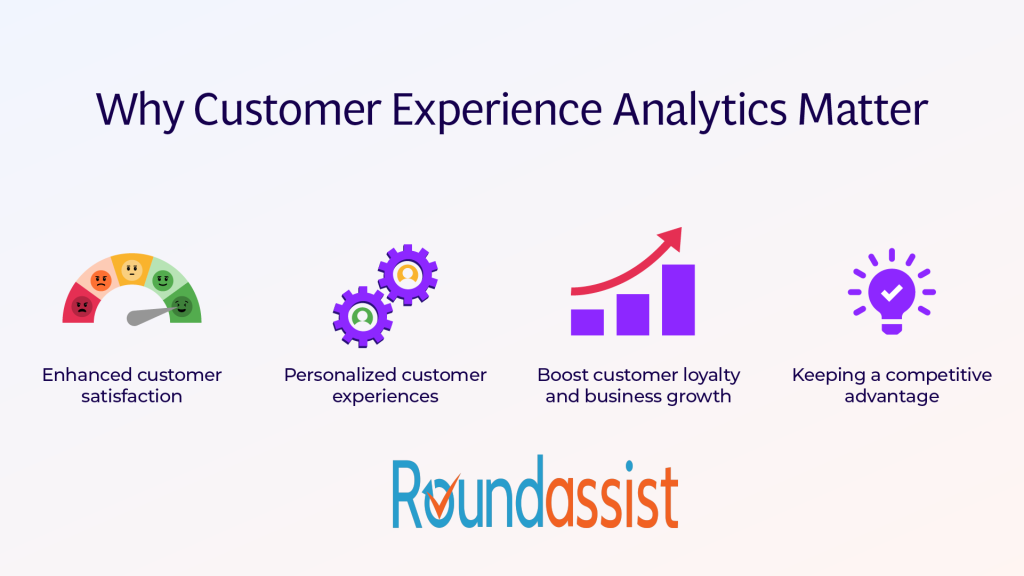
Why Customer Experience Analytics Is Essential
Nearly 90% of customers believe CX is as important as the product or service itself.
Understanding CX performance allows companies to:
- Build stronger marketing and service strategies
- Stay competitive in crowded markets
- Improve customer satisfaction and loyalty
- Increase retention and reduce churn
- Strengthen reputation through consistently positive experiences
Customers who receive great service are far more likely to recommend your brand, creating organic growth. Meanwhile, CX analytics helps staff understand what works, where performance slips, and what requires immediate improvement.
Key Benefits of CX Analytics
1. No More Guessing About Customer Needs
Customers don’t always articulate what they expect.
Analytics uncovers behavioral signals and pain points, enabling teams to fix issues before they escalate and streamline workflows for speed and efficiency.
2. Better Personalization Across All Touchpoints
More than 70% of customers expect personalized interactions (McKinsey).
Data from multiple channels helps create a complete, accurate picture of customer preferences, enabling:
- Tailored recommendations
- Audience-specific messaging
- Personalized service strategies
This combination of data, AI, and human insight drives loyalty and boosts revenue.
3. Higher Operational Efficiency
CX analytics uncovers inefficiencies, repeated customer pain points, and outdated workflows.
Examples include:
- Detecting tasks that require automation
- Reducing manual work for agents
- Improving resource allocation
- Lowering operational costs
4. Data-Driven Decision Making
Analytics clarifies which channels perform best and where to focus service, sales, and marketing resources.
KPI dashboards help evaluate satisfaction, loyalty, and overall CX impact.
5. Improved Employee Performance
Consistent analysis uncovers performance gaps, enabling:
- More targeted coaching
- Better customer service scripts
- Lower stress for agents
- Higher service consistency
RoundAssist also provides customer support consulting services to help teams close performance gaps and elevate service quality.
Top CX Analytics KPIs and Metrics
To optimize customer experience, organizations rely on several high-impact KPIs.
CSAT — Customer Satisfaction Score
CSAT measures how happy customers are after interacting with your service or using your product.
Usually collected through post-interaction surveys (1–5 or 1–10 rating).
To enhance accuracy, companies combine surveys with:
- AI-powered call transcription
- Sentiment analysis
- Tone and behavior interpretation
This helps evaluate satisfaction even when customers skip surveys.
NPS — Net Promoter Score
NPS measures how likely customers are to recommend your company.
Customers fall into these categories:
- Promoters — enthusiastic, loyal, refer new clients
- Passives — neutral, may switch to competitors
- Detractors — unhappy, may advise others to avoid the brand
Understanding detractor feedback reveals which CX issues require urgent attention.
CES — Customer Effort Score
CES shows how easy it was for a customer to resolve an issue.
Customers rate the difficulty on a scale of 1–10.
Low-effort interactions = higher loyalty.
High-effort interactions = frustration and churn.
Churn Rate
Churn measures the percentage of customers that stop using your product or service.
A high churn rate signals problems such as:
- Poor onboarding
- Product quality issues
- Inefficient support
- Better competitors
- Failed CX initiatives
Analyzing churn helps companies predict revenue, refine the marketing budget, and improve retention strategies.
CLV — Customer Lifetime Value
CLV represents the total revenue a customer is expected to generate over time.
High CLV means:
- Strong loyalty
- Sustainable revenue
- Healthy customer relationships
Predictive analytics can identify high-value segments and guide personalization, loyalty programs, and tailored retention strategies.
How to Use CX Analytics Effectively
1. Define Clear CX Goals
Examples:
- Reduce churn
- Improve CSAT or NPS
- Increase retention
- Improve onboarding
- Boost support efficiency
2. Gather Data From Multiple Sources
Include:
- Behavioral data
- Feedback (CSAT, NPS, reviews)
- Operational data
- Demographic data
Tools often used:
CRMs, Google Analytics, Qualtrics, social listening tools, support platforms.
3. Organize and Analyze Your Data
Use methods such as:
- Data cleaning
- Descriptive statistics
- Regression and correlation analysis
- Cluster analysis
- Sentiment analysis
- Predictive analytics
- AI-powered CX insights
Map the customer journey, identify drop-off points, and understand satisfaction drivers.
4. Build a Strategy Based on Insights
Use your findings to:
- Launch new CX initiatives
- Optimize workflows
- Automate repetitive tasks
- Implement chatbots for FAQs
- Personalize communication
- Improve service delivery scripts
- Train staff on updated processes
5. Monitor Continuously
CX analytics isn’t a one-time project.
Regular monitoring helps detect new trends, track progress, validate strategies, and future-proof operations.
Conclusion
Customer experience analytics empowers companies to understand how customers truly feel about their products, services, and support interactions. By addressing pain points and optimizing internal processes, organizations can improve satisfaction, strengthen loyalty, and remain competitive in any market.
RoundAssist helps companies turn CX analytics into actionable improvements — from strategy to execution.
Ready to elevate your service quality? Request your custom quote today.